Ewan LEMONNIER & Etienne LE GOURRIEREC|20 November 2023, updated April 2026
Introduction
April 2026 update: this article was originally published in November 2023 and has been refreshed. The RAG pipeline concepts (chunking, embedding, retrieval, cosine similarity, System/Context/Query/Assistant prompt structure) are still relevant and have become the production standard for enterprise document chatbots. The model, framework, and provider landscape, however, has evolved significantly: we have updated the relevant sections (2026 models, context windows, sovereign open-source, mid-market use case with metrics).
Context
In the modern world, applications such as ChatGPT, based on LLMs (Large Language Models), are becoming ubiquitous. Their potential extends across all sectors, from customer service to human resources management, offering tailored solutions to problems of all kinds
The many announcements from industry leaders underline the democratization of AI. The constant evolution of tools allows companies to foresee prospects for performance and operational efficiency thanks to GenAI
From internal R&D to a mid-market use case
Originally, Nobori launched an internal R&D initiative in 2023 to understand and master the key GenAI concepts. By 2026, the topic has moved beyond R&D: a RAG document chatbot is now a standard use case for mid-market CIOs, with mature tooling and inference costs divided by 10 in two years. The question is no longer “how does it work” but “how do we scope a POC that delivers measurable business value in 6 weeks, without sliding into an 18-month project”.
Our R&D has led us to develop a chatbot that implements RAG (Retrieval-Augmented Generation). A chatbot is simply a conversational agent, which in our case relies on an LLM to generate answers to the user’s questions
Two problems are regularly encountered when interacting with LLMs:
Hallucinations: a model’s ability to fabricate information during text generation.
Outdated answers: some of the information used by models may come from sources that are out of date at the time of generation
RAG aims to alleviate these problems, by implementing an information retrieval system to provide the model with context when generating responses. This fundamental concept makes it possible to enrich text generation by extracting relevant data beforehand to contextualize and improve the accuracy of answers
High-level view of the PoC
This PoC is an application that lets you talk to a chatbot. You provide it with documents, such as texts or articles, and then you can ask it questions. It will respond with information or thoughts based on the documents you’ve previously provided.
Mid-market use case template: an internal assistant capable of answering, with sources, on a base of 5,000 documents (quality policies, regulatory procedures, customer contracts, support knowledge base) accessible to 200 business users. Quantified target: cut by at least 50% the average compliance information lookup time for operational teams.
The typical success metrics for such a POC, observed across our engagements:
End-to-end latency < 4 seconds (from question to full answer)
User satisfaction > 70% (measured via thumbs-up/thumbs-down embedded in the UI)
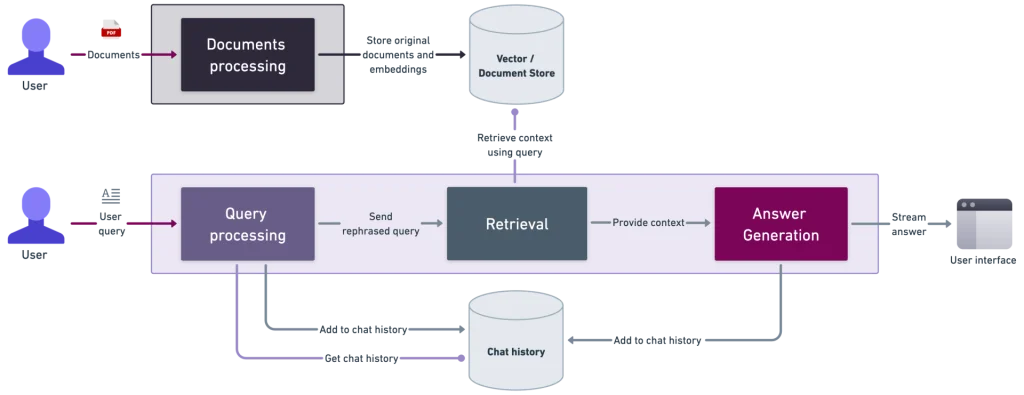
Below is a diagram of the general operation, which will be explained in detail throughout this article:
First, the user uploads their documents, which go through a step of Document Processing before being stored.
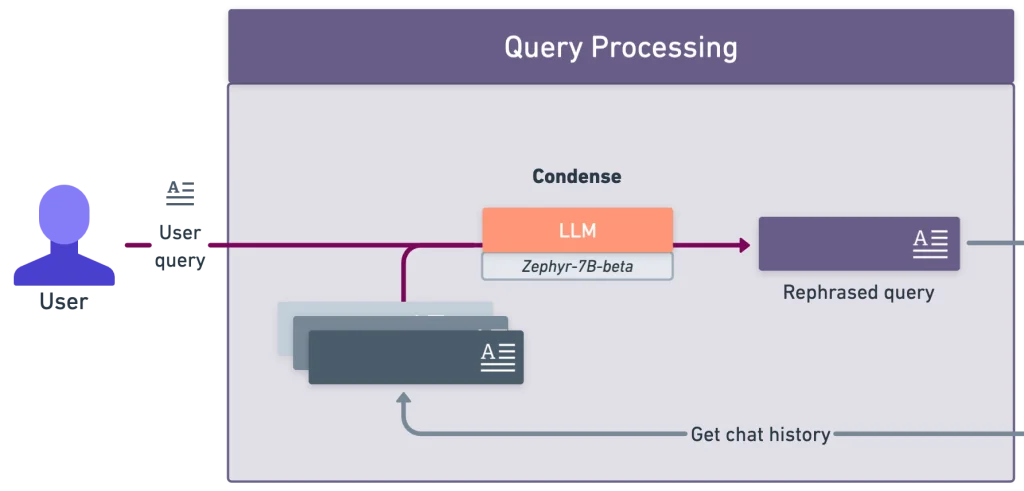
The user then interacts with the application as with a conventional chatbot. During Query Processing, the question is reformulated to include the conversation history, and used for the rest of the process.
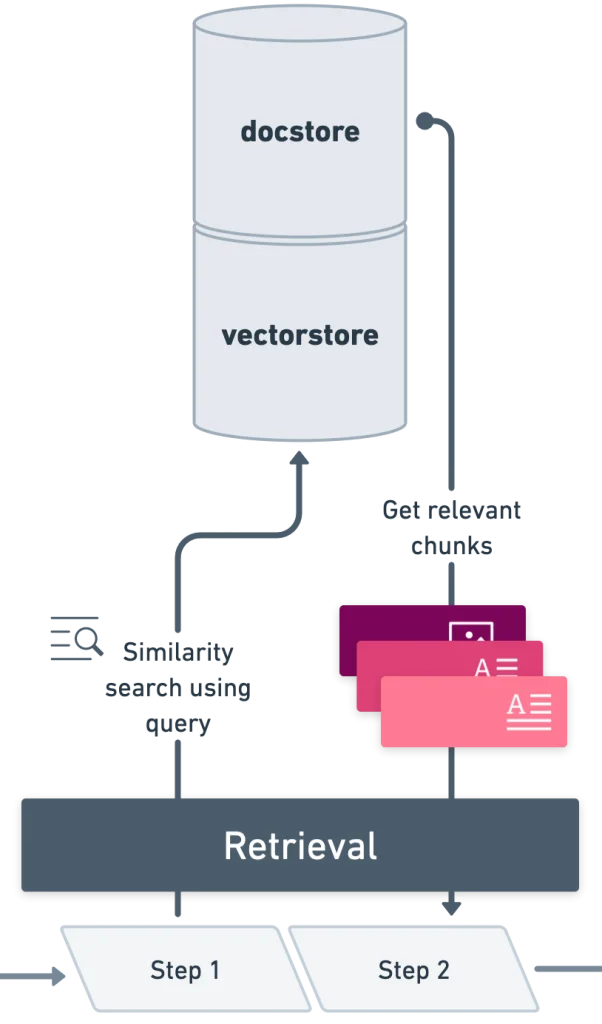
The Retrieval phase is the core of a document-based Q&A application. The aim is to find relevant information in the documents, based on the user’s query. This information serves as context for answering the query.
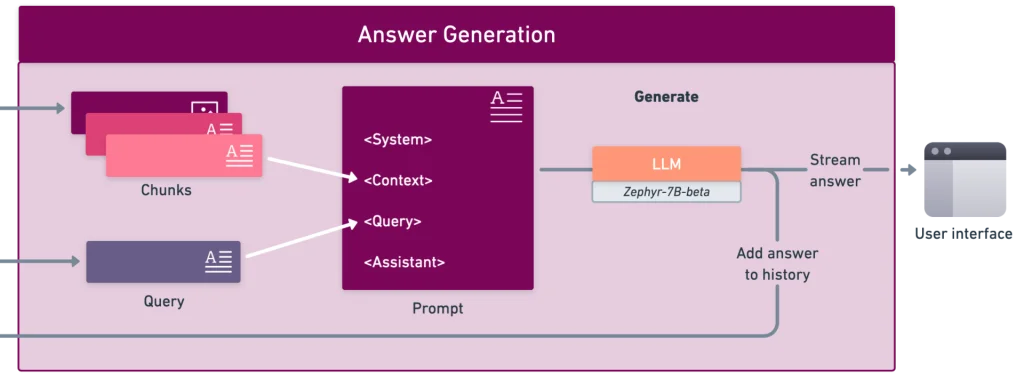
Once the context and the question have been obtained, they are passed on to the final prompt, which is then used by the model to generate our answer. This concludes the Answer Generation step!
Technological landscape
We first looked at a number of existing open-source solutions that partially met our requirements, to understand how they worked and how their projects were structured. These included h2oGPT and PrivateGPT. When testing them, they proved insufficiently flexible, and we were looking for an application offering long-term modularity
Since we couldn’t find a suitable solution, we decided to develop our own application. We explored framework options to start developing the PoC. We made a comparison between LlamaIndex and LangChain, and finally opted for the latter. It has concrete examples illustrating the various concepts it implements, as well as extensive and explicit documentation. In addition, the project’s GitHub was much more active at the time, which is a major argument to consider when choosing an open-source framework.
2026 update, LangChain vs LlamaIndex: since 2023, LlamaIndex has largely caught up on documentation and community, and remains more specialized for pure RAG. The choice between the two has become genuinely contextual: LangChain for multi-component pipelines (agents, tools, advanced memory), LlamaIndex for strict document RAG. A third option has emerged: Haystack 2.x (deepset), often retained in European contexts for vendor sovereignty reasons.
Once the choice of framework was made, we needed to figure out a way of accessing models. We interact with an LLM through API requests or via a CLI. Two hosting methods are available:
Running a model locally or on sovereign infrastructure, with Ollama, vLLM, or a dedicated GPU cluster. The LLM then runs on your own architecture, a key argument for mid-market companies subject to data sovereignty constraints.
2026 model landscape: the current version of the POC makes it easy to interchange the model(s) used, including notably:
Premium cloud models: Claude 3.7 Sonnet, GPT-4o / GPT-4.1, Gemini 2.5 Pro, Mistral Large 2.
Compact local models (laptop or single GPU): Llama 3.3 8B, Mistral Small, Phi-4.
This interchangeability has become a more important design criterion than the choice of a single model: competition between providers and the rapid improvement of open models make any exclusive choice quickly obsolete.
Focus on the notions of Prompt and Chain
Before getting into detail, let’s simply cover two important notions to keep in mind for the rest of the article:
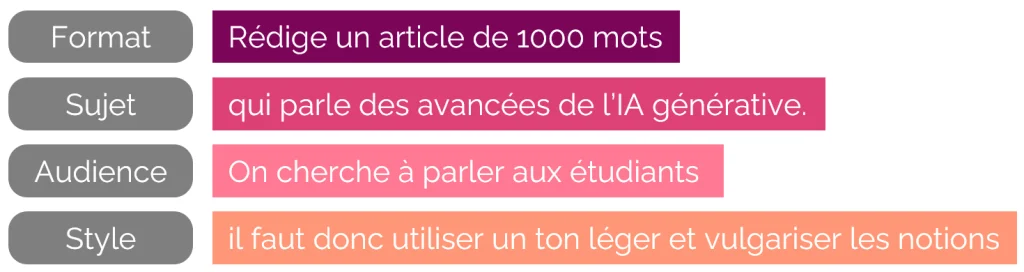
Prompt: a series of instructions written in natural language, given to the model to indicate what is expected of its response. This prompt can be a question, a sentence starter, or even a combination of several elements, and serves as a guide for generation. It conditions the model’s understanding of the task in hand, and directly influences the nature and content of the output response
Prompt example
Chain: the use of an LLM in isolation is appropriate for simple applications, but more complex applications require the chaining of several LLMs, either with each other or with other components. One of the fundamental principles of the LangChain framework, from which it takes its name, is the concept of chain. A chain is defined very generically as a sequence of calls to different components managed by the framework (prompt, LLM, memory, etc.), which may themselves include other chains
In-depth process analysis
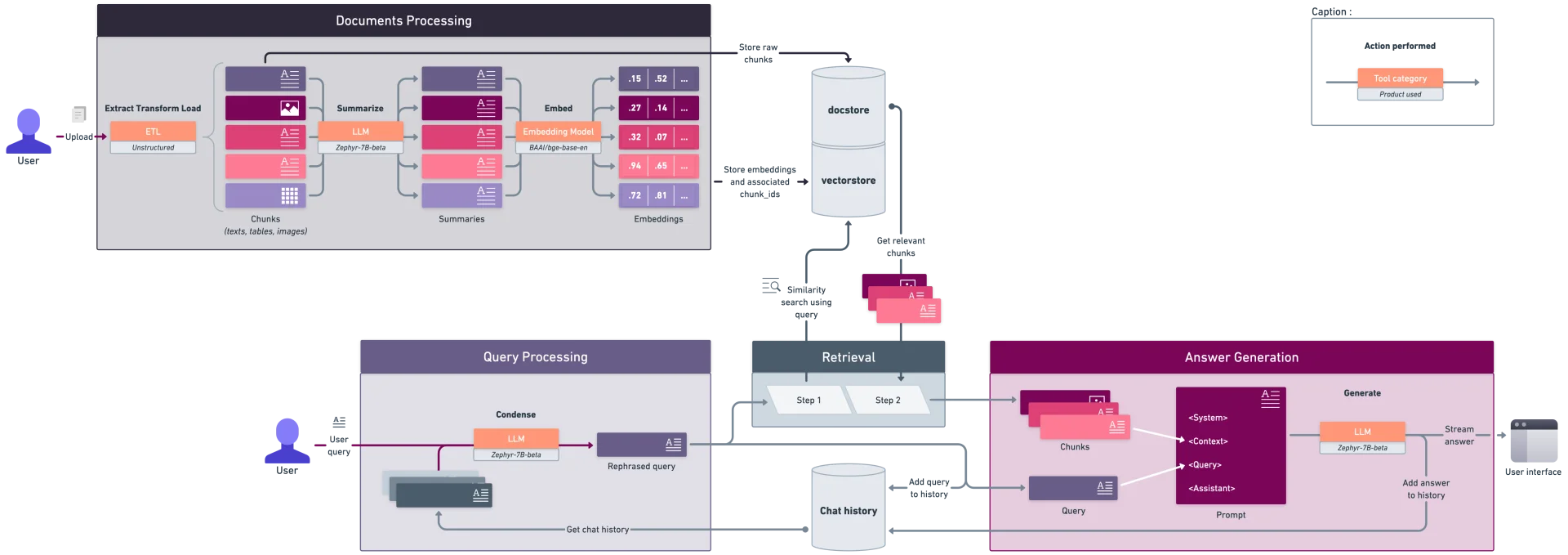
With these concepts in mind, we can get to the core of the explanations, starting with a more detailed version of the diagram presented earlier:
This representation provides a complete view of how each part of the process works and how they are interconnected
1. Documents processing
There are two types of data: structured and unstructured. To operate at their best, LLMs need to be fed with clear, well-organized data
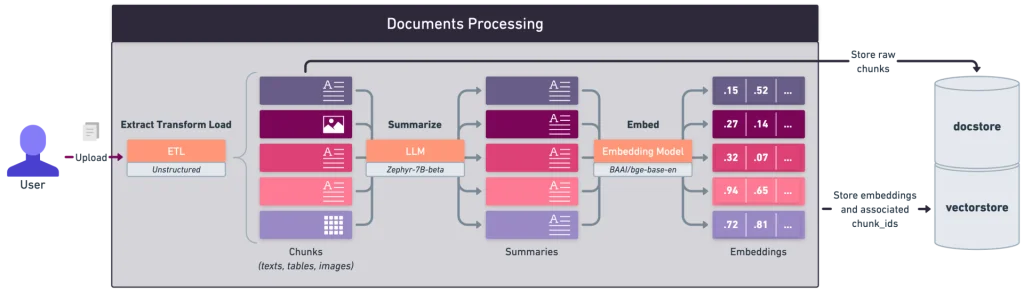
When the information comes from databases or tools like Notion, which store data in a structured way, it’s easy to use. In our case, we’re dealing with PDF documents, which fall into the category of unstructured data. To manage the extraction of elements from this type of document, we use the ETL (Extract, Transform, Load) named Unstructured
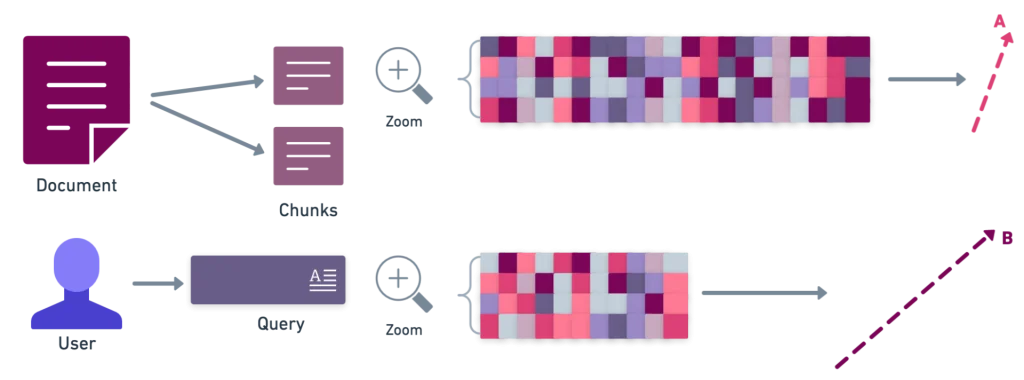
Document processing management is based on the Parent Document concept. The original document is broken down into sections, called chunks, which are then stored
Modifications are then made to these chunks, such as the creation of summaries (chunks could also be divided again to obtain smaller sections). An ID maintains the link between the original chunks and the summarized chunks, which are then saved as embeddings. This method makes it easy to search through embeddings and still obtain usable results
But what does embedding mean? Let’s find out!
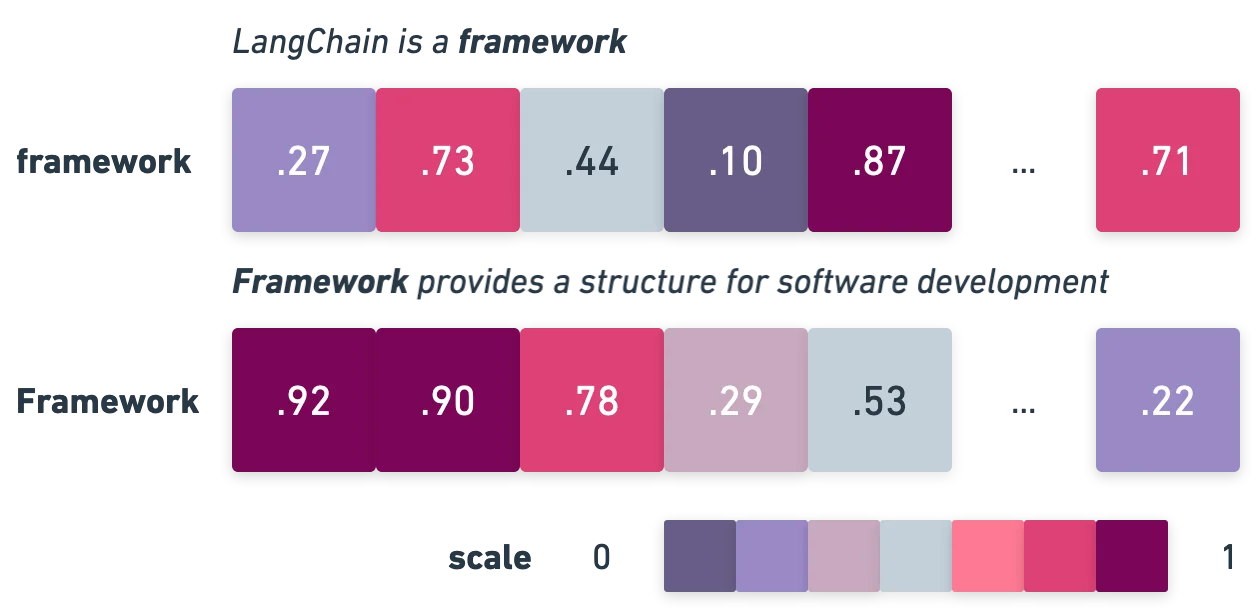
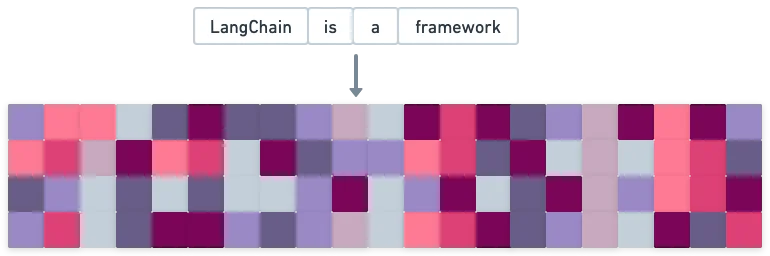
An embedding is a vector representation commonly used by AI models to facilitate data manipulation.
In our case, a word embedding can have hundreds of values, each representing a different aspect of a word’s meaning. Example with the word “framework” in the sentences “LangChain is a framework” and “Framework provides a structure for software development”.
As the model processes the set of words represented by a sentence, in this case “LangChain is a framework”, it produces a vector – or list of values – and adjusts it according to the proximity of each word to other words in the training data.
At the end of the document processing step, a mixed storage is obtained, containing both chunks and embeddings. This storage will be used in the Retrieval phase, which appears later in the process
2. Query processing
Processing the user’s query involves a rephrasing step based on the chat history. This allows the information previously exchanged to be integrated into the new question
Here’s an example of a prompt that could be used for this purpose:
Given the following conversation and a follow up question, rephrase the follow up question to be a standalone question.At the end of standalone question add this 'Answer the question in {language}.'Chat History:{chat_history}Follow Up Input: {question}Standalone question:
Variables between curly brackets are replaced by their value when the prompt is used
3. Retrieval
This phase is the core of a document Q&A application. As previously mentioned, the retriever is based on a mixed storage:
docstore: chunks of original documents
vectorstore: embeddings of chunk summaries
In our case, the documents (docstore) are stored in RAM, while the vectorstore uses a vector database called ChromaDB
We then perform a similarity search on the contents of the vectorstore, using the rephrased question obtained earlier, and in return we get the chunks containing the relevant information that will serve as context for the final LLM
We thus succeed in retrieving chunks present in the original documents that contain information useful for generating the answer
Let’s take a closer look at similarity search:
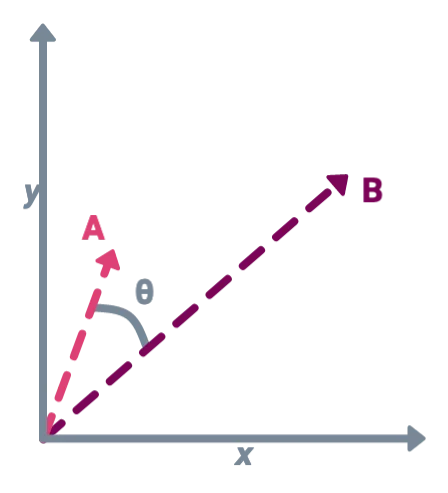
Similarity search can be applied in various ways. For the purposes of this article, we’ll focus solely on the one we use, namely cosine similarity. This consists in finding the vectors closest to the one representing the question formulated by the user.
Mathematically, cosine similarity calculates the angle between two vectors in a multi-dimensional space, based on the concept that vectors pointing in similar directions are considered similar.
The smaller the angle, the more similar the vectors.
It is thanks to this mathematical formula that the retriever works out which document chunks are most relevant to the user’s question
We now have everything we need: a question and the information required to answer it. All that’s left is to make use of them to conclude the process
4. Answer generation
The prompt used by the LLM to generate the final response is made up of several sections, those collected in the previous steps and others pre-written:
The “System” section is hard-coded in the prompt. It is used to tell the model what behavior to adopt and how to generate the response.
The “Context” section contains the chunks of documents used as context to generate the response.
The “Query” section contains the user’s question, reformulated with the chat history.
The “Assistant” section is also hard-coded, and specifies where the model should start generating
To facilitate the use of the PoC, the generated content is sent directly to the user interface. We are currently using Streamlit, a solution offering easy-to-use features for the development of LLM-based applications
This concludes the explanation of how the PoC works, and leads to an opening on the challenges encountered during development and the limitations of the product in its current state
Challenges and limitations
Prompt Engineering: One of the most important areas for improvement in the PoC results is prompt engineering. The application is based on chains made up of different LLMs, and their prompts are key to increasing the relevance and quality of responses
Context quality and size: In this version of the PoC, we choose to summarize the chunks of the original documents and store them as embeddings. In reality, we could simply store several versions of the chunks without making summaries, to avoid losing information. To do so, we would have to split the chunks again, and keep all the embeddings in our storage. 2026 update: context windows have exploded: 1M tokens with Claude 3.7 and Gemini 2.5, 200k with GPT-4o. The temptation is strong to “push everything into the context” and skip RAG. In practice, on bases larger than 50,000 documents, retrieval remains superior in cost, latency, and precision. RAG was not killed by long context, it became the production standard. Security and sovereignty: the #1 concern of mid-market CIOs in 2026 remains data hosting (PII, GDPR, business secrets). It is the main argument pushing toward self-hosted open-source models or cloud providers with European contractual guarantees (Mistral La Plateforme, Azure OpenAI EU region, Vertex AI EU region)
Generic chunk storage: The last point to mention is the storage of original document chunks used by the retriever. The PoC manipulates both text and tables, but does not store chunks from one session to the next. This is due to the fact that currently, the framework does not offer the possibility of storing different types of chunks other than in RAM. This slows down testing and is not a viable long-term solution. If, in the future, the PoC has to manage images as well, as mentioned in this article, this problem will become even more widespread. It will then be necessary to set up storage that can handle text, tables and images, while still being usable by the retriever
Conclusion
At our scale, we do not claim to develop a product capable of answering every problem, but a solution capable of handling specific use cases
As stated in the limitations, the emphasis is placed on improving results through document processing. We are keeping an eye on the evolution of RAGs in order to process documents more efficiently. With this in mind, we are currently exploring solutions to make our RAG multimodal, i.e. we could process images in the same way as text or tables
2026 update, open source has made a leap in two years: Mistral AI (Mistral Large 2), Llama 3.3 70B, Qwen 2.5 72B, and DeepSeek R1 match or exceed GPT-4o on many public benchmarks. For a mid-market company subject to sovereignty constraints (healthcare, defense, regulated finance), the “self-hosted open-source model” option has become technically and economically credible, a 2x H100 cluster is enough to run a 70B model in production with reasonable throughput.
Checklist: 5 questions to ask before launching a RAG POC in a mid-market company
Business scope: which population, which document base (volume, types, update frequency), which priority use case? Without a clear answer, the POC drifts into an open-ended project.
Document base quality: are your documents up to date, deduplicated, readable (vs un-OCRed scans)? Retrieval quality is capped by base quality, and a prior cleanup determines 60% of success.
Hosting model and sovereignty: is data on an external cloud API acceptable, or is a sovereign model needed (EU region, in-house infrastructure)? The answer drives the model choice and architecture, not the other way around.
Measurable success KPIs: sourced answer rate > 90%, latency < 4s, business time saved > 50%. Without quantified KPIs before kick-off, it is impossible to declare the POC a success or failure.
Production plan from day one: who operates, who feeds, who measures? A POC without a production plan ends up as an orphan demo and a wasted budget.



 Retour
 Ewan LEMONNIER & Etienne LE GOURRIEREC|20 November 2023, updated April 2026